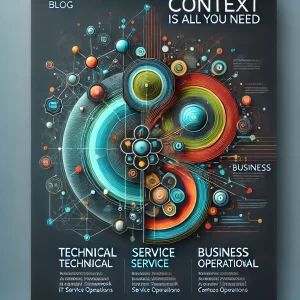

In the ever-evolving journey through our Service Ops Building Blocks series, we’ve explored the granular mechanics of alert management and the transformative shift to dynamic baselines, and now, we navigate the intricate web of end-to-end service maps within the realm of AIOps. This exploration is not merely about delving deeper into the applications themselves but about broadening our perspective to encompass the business capabilities, services, and offerings they underpin. It’s about answering the fundamental question of ‘why?’ – Why is a particular application, service, or transaction critical to our operations? The answer lies in the comprehensive understanding of how these technological elements are intertwined with the business’s core functions and, ultimately, its value to customers.
Beyond Technology: Mapping to Business Value
End-to-end service mapping in the context of AIOps transcends traditional IT management. It’s a holistic approach that seeks to chart the complex relationships between IT infrastructure and the business capabilities it supports. These maps are not static diagrams but dynamic, living entities that adapt as new services are deployed, existing ones evolve, or the underlying infrastructure changes. They provide a bird’s eye view of how each component contributes to business operations, offering clarity on the impact of technological performance on business outcomes.
The Imperative of Understanding Business Impact
At the heart of effective AIOps-driven IT operations is the ability to not just detect and rectify issues but to prioritize them based on their business impact. Understanding your end-to-end service maps is crucial because it allows IT teams to answer why a failing application or a degrading service matters. It connects the dots between technical performance and business priorities, highlighting which services are critical to customer satisfaction, revenue generation, or compliance with regulatory requirements. This insight ensures that IT efforts are aligned with business objectives, focusing resources on areas of highest value and impact.
Strategies for Effective Service Mapping in AIOps:
- Comprehensive Data Collection: Begin with gathering detailed data across your IT landscape, including applications, servers, databases, and network devices, ensuring you have the foundation to build accurate service maps.
- Collaboration Across Departments: Engage with stakeholders from business units, application teams, and IT operations to ensure a holistic understanding of how technology supports business processes and objectives.
- Leverage AIOps for Dynamic Mapping: Utilize AIOps tools capable of processing large volumes of data in real-time to dynamically update service maps, reflecting changes in the environment or business priorities.
- Prioritize Based on Business Impact: Use the insights from your service maps to prioritize actions and allocate resources based on the potential impact on business operations and customer experience.
- Continuous Evolution: Treat service maps as living documents that evolve. Regular reviews and updates are essential to maintain alignment with the changing business landscape and IT infrastructure.
Conclusion:
Understanding end-to-end service maps is not just about comprehending the technological underpinnings of your business; it’s about grasping the very essence of why your IT operations matter. In the age of AIOps, where decisions are driven by data and automated processes, losing sight of the business context can render even the most advanced operations ineffective. By placing a premium on understanding the linkages between your applications, infrastructure, and business capabilities, you ensure that your IT operations are not just efficient but fundamentally aligned with your business’s core mission and values. This alignment is what transforms good IT operations into great ones, elevating the role of IT from a support function to a strategic partner in driving business success.