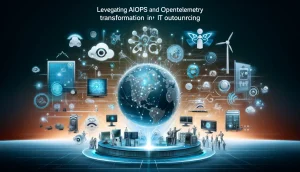

In just two years, we could be standing on the brink of a transformative leap in AIOps. One driven by Generative AI that redefines Service Operations, completely eliminating the need for humans to sift through a deluge of events. Instead, the future promises a seamlessly orchestrated interplay of technology and intelligence, predicting, understanding, and managing issues without human intervention. Let’s take a deep dive into this potential evolution—one where ‘ChatOps’ will transform the very fabric of IT operations, and Generative AI becomes the ultimate conductor in a symphony of self-resolving systems.
AIOps: The End of the Human-Event Relationship
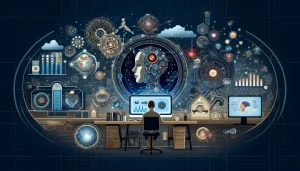
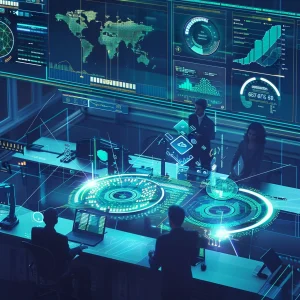
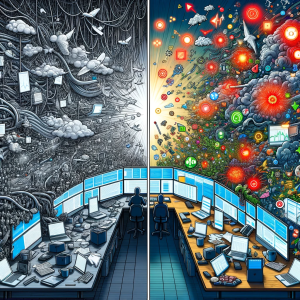
Picture a landscape where no IT operator ever looks at another metric/log/trace or event. No blinking lights on a control panel, no endless streams of logs demanding a human eye. GenAI-driven AIOps will make this happen—not through brute force, but by true contextual understanding.
Generative AI will learn from the past, master the nuances of events, signals, and their ripple effects. It won’t merely detect anomalies, but also comprehend—at a deep, semantic level—the technology stack in its entirety. Whether it’s a database lagging, a network packet lost in transit, or an obscure API call timing out, the AI will inherently know not only that something is wrong but exactly where, how, and why.
Consider the beauty of a completely autonomous system that identifies an issue before it becomes critical, assesses its impact—both on digital transactions and on customer experience—and kicks off the exact workflow required to mitigate the situation. The entire lifecycle of an event, from detection to triage to resolution, will be absorbed by the system, bypassing the need for human operators to play the middleman.
End-to-End Automation and Real-Time Customer Impact Analysis
This next-gen AIOps will understand the real-world impact of issues as well—not just at the infrastructure layer but from a business perspective. The AI will translate metrics and anomalies into tangible, real-time impact statements: “This API degradation is currently affecting 3% of checkout transactions for UK customers, leading to an estimated revenue impact of £20,000 over the next hour. The AI understands how this issue could cascade through the broader service architecture, potentially affecting customer sentiment if left unresolved. The system will also prioritise mitigation efforts accordingly, suggesting immediate actions to minimise both financial losses and customer dissatisfaction.”
By synthesising technical events into business language, this AI evolution will align IT operations with business outcomes—making it far easier to prioritise responses based on true urgency. The AI will see beyond logs and metrics; it will witness business flow disruption and initiate action according to business-critical priorities.
Raising Incidents with Complete Context—No Piecemeal Data
Generative AI’s capacity for contextual understanding will revolutionise how incidents are raised. Today, operators often play detective—assembling data from disparate monitoring tools, tracing root causes, and adding context before raising incidents. In the near future, this detective work will be fully automated.
The AI will gather data from observability platforms, correlate events across domains, and present incidents complete with rich context—impacted services, probable root causes, related historical incidents, and suggested remediation steps. No longer will engineers receive a cryptic ‘something is wrong’ alert. Instead, they’ll get an incident that reads like a narrative: “Service degradation detected in Payment API. Root cause suspected in database latency spike. Similar to incident #4127 from June. Suggested actions: increase database read replica count…. would you like me to action this for you?”
ChatOps: Collaborative Resolution, Driven by AI
Now, let’s go even further—because simply raising a well-contextualised incident is not enough. Enter ChatOps powered by GenAI. Imagine an AI that not only raises incidents but initiates a conversation with technical staff, becomes part of the team, and assists through every step of resolution.
The AI will actively engage engineers in collaboration channels. “I’ve raised Incident #5921 due to increased latency in the Order Management System. Would you like me to spin up additional compute resources to mitigate this?” The AI, having access to playbooks, historical resolutions, and contextual awareness, will not just propose a fix but will debate it, iterate on it, and even implement it when given the go-ahead—all within the chat interface.
AIOps as the Ultimate Partner—Not a Tool
The GenAI-driven AIOps of the future won’t be a tool; it will be a partner. This AI will adapt its communication style based on the audience—offering highly technical root cause data to engineers while simplifying insights for non-technical stakeholders. It will remember preferences: “Last time we faced this issue, we patched the service immediately. Shall we do the same now?” It will learn, evolve, and get better with every interaction, becoming an indispensable member of the IT operations team.
We can also envision a world where the AI analyses not just the technical aspects of incidents but the people dynamics as well—predicting which engineers have the expertise and capacity to resolve the issue most effectively and engaging them directly. GenAI will use natural language generation to communicate clearly and persuasively, getting the right people involved at the right time.
A Two-Year Horizon Full of Potential
Within the next two years, I see GenAI in AIOps fundamentally changing how we operate. The future will no longer be about simply reacting to events—it will be about predicting, understanding, contextualising, and resolving them in an ongoing, fully automated loop. The AI will manage not just incidents but workflows, actions, and even human collaboration, driving outcomes that directly align IT stability with business value.
This shift will allow technical teams to focus on proactive innovation rather than firefighting—freeing up time to develop new features, optimise services, and deliver real business impact. Generative AI will be the linchpin that makes IT operations invisible, frictionless, and fundamentally aligned to the business—where technology works in service of human creativity, not the other way around.
In this vision, AIOps becomes an orchestra—conducted by an AI with infinite attention to detail and perfect contextual awareness—leaving humans free to compose new symphonies of innovation, without worrying about which server or API has missed a beat.
If you’re considering AIOps for your organisation, it’s a good idea to start by evaluating your current AIOPs maturity. Taking a gradual approach can help you understand the benefits while minimising disruptions. Feel free to contact me if you have questions or need guidance on starting your journey!