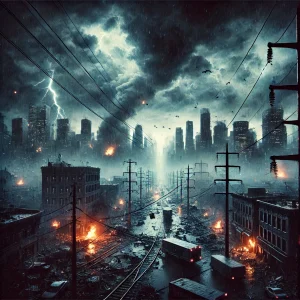

The electric grid – an intricate, largely invisible web of infrastructure – is the backbone of modern life, providing power to our homes, businesses, and hospitals. My story, The Day the Grid Went Dark, vividly depicts a catastrophic grid failure and its profound consequences. In this blog, I’ll explore the real-world plausibility of such a scenario, citing historical examples, examining the socio-economic impact, and reflecting on the lessons that need to be learned.
What Could Cause a Complete Grid Failure?
The fictional story starts with a small, seemingly inconsequential fault that snowballs into a cascading grid failure. In reality, power grids operate with a delicate balance, and faults can indeed spiral into large-scale failures. A striking real-world parallel is the 2003 Northeast Blackout in the United States and Canada, which affected over 50 million people. This blackout started with a transmission line sagging into an overgrown tree, triggering a cascading failure across interconnected power systems. Poor coordination and slow response were significant contributing factors, echoing the human and system flaws seen in my story.
Another historical incident occurred in India in 2012, where two back-to-back blackouts left around 620 million people without electricity—nearly 9% of the world’s population at the time. The primary causes were an overdraw of power from the grid, insufficient redundancy, and a lack of effective coordination between regional operators. These examples show that cascading failures, as described in my narrative, are plausible and have happened in recent history.
The Immediate Impact: Lives in Peril
The story graphically portrays hospitals in disarray, surgeries halted, and medical equipment failing as backup generators proved inadequate. This element is chillingly plausible. In 2017, Hurricane Maria in Puerto Rico left the island’s medical infrastructure crippled, leading to the loss of many lives due to power shortages in hospitals. A study later found that nearly 3,000 people died due to delays in medical care, in line with what my story describes—how vulnerable populations, particularly those dependent on medical devices, are at extreme risk during extended outages.
In Texas, during the 2021 winter storm, widespread power outages affected millions, leading to several hundred deaths. People succumbed to hypothermia, and many were left without access to water as electrical outages caused water treatment facilities to fail—similar to the challenges depicted with water supplies in high-rise buildings in my story. Such incidents underscore the critical dependency on a stable grid not just for comfort but for survival.
Transportation Chaos and Economic Disruption
My story describes traffic lights failing, emergency services being overwhelmed, and manufacturing plants grinding to a halt. These are common consequences in large-scale outages. During the 2003 Northeast Blackout, traffic in major cities like New York came to a complete standstill, with intersections clogged due to non-functioning signals, just as in my fictional account.
The economic cost of grid failures can be staggering. The 2012 Indian blackout caused severe disruptions to industries, agriculture, and transportation. Estimates suggest it costs billions of dollars in lost productivity, highlighting the financial vulnerability of economies reliant on electricity. Similarly, in the story, factories halt operations and experience equipment damage due to sudden power cuts. This mirrors real incidents where abrupt outages lead to machinery malfunctions and production loss, particularly in sensitive industries like chemical processing, where temperature control is vital.
The Struggle to Restore Power
The restoration efforts in the story describe engineers working tirelessly to balance loads and bring the system back online segment by segment. This process, known as a black start, is an incredibly delicate operation, requiring careful reintroduction of power without overloading the fragile, recovering grid. During the 2003 blackout, the grid restoration took over 30 hours, illustrating just how complex and painstaking such recovery efforts are.
In 2019, a blackout in Argentina, Uruguay, and parts of Paraguay affected over 48 million people. It took several hours to restore the power, with engineers needing to manually assess damage, isolate affected sections, and gradually reconnect them. This real-life event reflects the manual intervention and painstaking recovery efforts depicted in my narrative—a reminder that even in highly automated systems, human expertise is indispensable.
The Human and Financial Costs
My story also captures the emotional toll: families separated, people unable to communicate, and an overwhelming sense of fear. In a hyper-connected world, the loss of electricity means the simultaneous loss of communication. In Puerto Rico after Hurricane Maria, families faced similar struggles—with mobile networks down, people couldn’t reach loved ones, causing widespread distress.
The financial burden described is also significant. The story mentions regulators imposing fines and a plummet in shareholder confidence. In real cases, like the California power outages linked to Pacific Gas & Electric (PG&E), legal liabilities and compensation claims have pushed utility companies towards bankruptcy. PG&E, for instance, faced billions of dollars in liabilities following wildfires attributed to faulty power lines, demonstrating the massive financial stakes when grid reliability is compromised.
Learning from Fiction and Reality
The story serves as a reminder of how much modern life depends on reliable electricity. It calls out several areas for improvement, which are also highlighted in real-world incidents:
- Investment in Infrastructure Resilience: The need for robust infrastructure is undeniable. In many past failures, aging equipment and poorly maintained lines have played key roles. Investing in modern, resilient grid components is critical.
- Testing and Redundancy: The story reveals flaws in automated systems that were inadequately tested. In reality, testing failover mechanisms under realistic conditions is crucial to ensure that backup systems perform as expected during a crisis.
- Comprehensive Disaster Recovery Planning: My fictional grid collapse highlights the importance of disaster recovery plans that are both well-designed and practical. Real incidents have often exposed the inadequacy of existing plans when scaled to real-world crises. Proper drills and scenario planning can prepare teams for effective response under chaotic conditions.
Conclusion
My fictional account of an electric grid failure provides a stark but necessary reflection on our reliance on electricity. By looking at real-world blackouts, it becomes clear that the events described are not just possible but have already occurred in varying degrees across the globe. The consequences—both human and economic—emphasise the need for a resilient grid infrastructure, rigorous testing of systems, and robust disaster recovery plans.
The cost of inaction is measured not only in financial terms but in human lives and societal stability. As we move towards an even more electrified and connected future, ensuring the robustness of our electric grid is not merely a technical necessity—it is a matter of life and death.
Sources
– 2003 Northeast Blackout: [Read more](https://en.wikipedia.org/wiki/Northeast_blackout_of_2003)
– India in 2012: [Read more](https://en.wikipedia.org/wiki/2012_India_blackouts)
– Hurricane Maria: [Read more](https://en.wikipedia.org/wiki/Hurricane_Maria#Impact_on_healthcare)
– Texas, during the 2021 winter storm: [Read more](https://en.wikipedia.org/wiki/February_2021_North_American_winter_storm)
– 2012 Indian blackout: [Read more](https://en.wikipedia.org/wiki/2012_India_blackouts)
– 2019, a blackout in Argentina, Uruguay, and parts of Paraguay: [Read more](https://en.wikipedia.org/wiki/2019_South_American_blackout)
– Puerto Rico after Hurricane Maria: [Read more](https://en.wikipedia.org/wiki/Hurricane_Maria#Impact_on_communications)
– California power outages: [Read more](https://en.wikipedia.org/wiki/Pacific_Gas_and_Electric_Company#Wildfires_and_blackouts)